Inside Tips to Max Out Your Agency's Sale Price

It’s no secret that the M&A market for agencies has been through a wide-scale transformation over the last few years. COVID-era deal activity surged, then pulled back. Valuations reset industry wide. And now, buyer interest is building again, albeit with sharper criteria. Where it was once sufficient to have a stellar service offering, buyers today are underwriting consistency, differentiation, scale, and increasingly, whether the business looks poised to succeed long term in a world being reshaped by AI.
In last week’s webinar (February 19, 2026), Andreas Roell (CEO of Evros Group) and Nii Ahene (Strategic Executive Advisor) walked through what they're seeing across the current deal landscape, sharing insights into what's driving valuations, where things go sideways, and what agency founders can do right now to strengthen both their sale price and their long term optionality. Here are five key takeaways from that lively conversation.
1. Deal activity is picking back up, but buyers have gotten more selective.
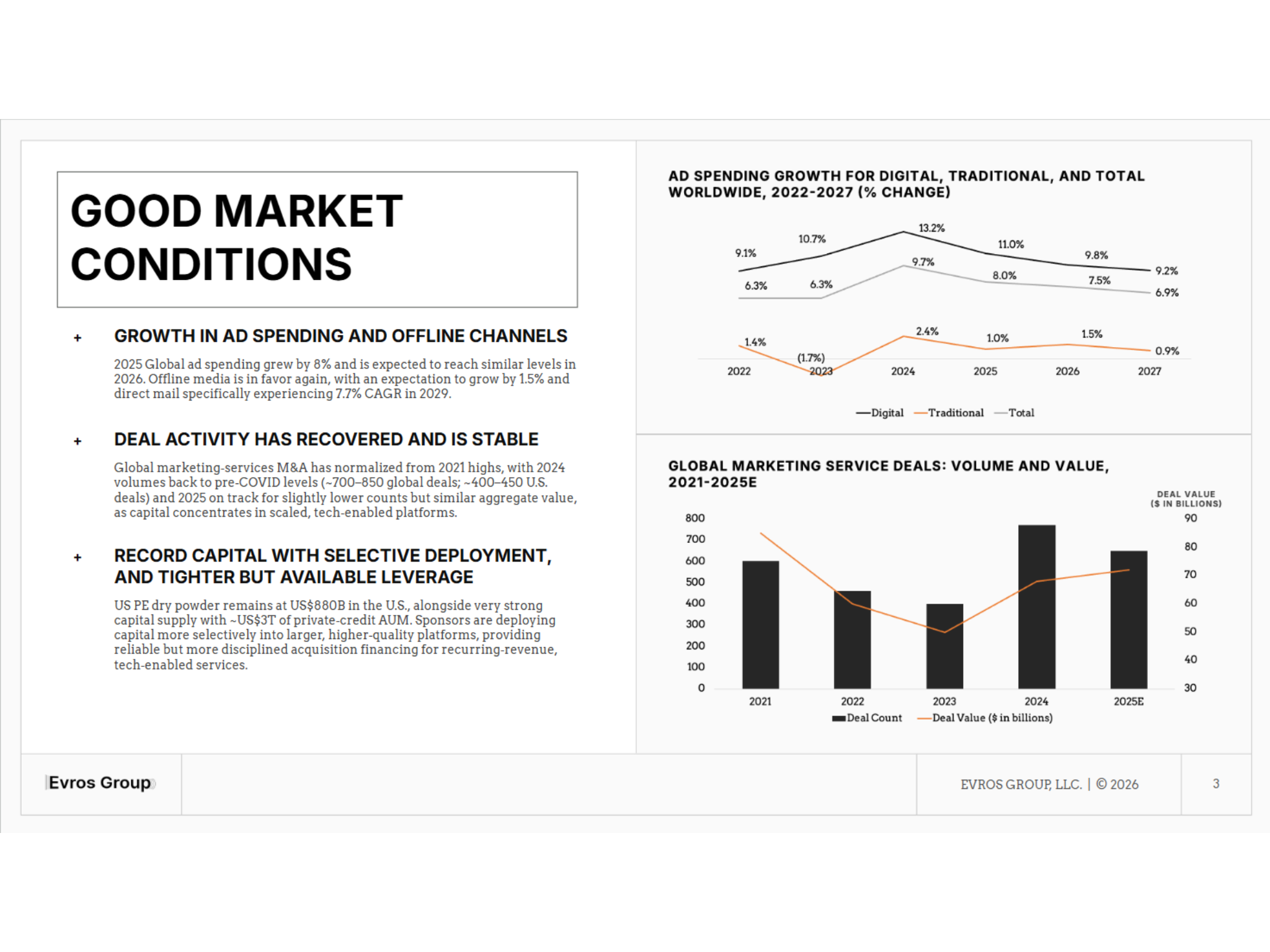
Andreas Roell kicked things off with a sentiment a lot of founders can relate to: after the post-COVID peak, deal volume slowed and valuations sagged. But since 2024, momentum has been building again. There's capital accumulating on the sidelines, and both strategic buyers and private equity have been more and more active in the space.
That said, renewed interest doesn't mean buyers are writing checks on potential alone. The bar has moved higher. And Roell pointed to three core items that buyers are now focused on:
Consistency of performance — growth and profitability that actually sustain over time.
Defensibility — can the business hold its value as tools and platforms shift?
Scale — larger deals attract more attention and premium valuations.
As he put it, the rising and falling tides through the COVID era have made investors increasingly keen to find businesses that cut through the noise, looking at groups that are poised to overachieve in both their current performance and future growth.
2. The best exits are engineered outcomes, not merely end points.
As Nii Ahene put it, one of the strongest things founders can do when eyeing a sale is to stop thinking of M&A as a finish line. Too many founders take an all-or-nothing stance — you either sell or you don’t. But in practice, there’s tremendous strength in being open to different transaction structures that match your actual goals — whether that’s liquidity, a growth partner, or a bigger platform to accelerate what you’re already building. As Ahene says, “You can design the end that you want.”
That could look like a minority investment where you get liquidity and a financial partner without fully stepping away. Or a platform partnership where you join a larger group but keep driving strategy.
The point here isn’t that a sale process is right for every founder, but that M&A is malleable and shouldn’t be treated as binary. Keeping yourself open to options fortifies your position and allows you to generate maximum value by staying aligned with your long-term goals.
3. Scale and specialization are premium fuel for valuations.
Another important theme crystallized in the conversation: your ability to scale has an outsized influence on what buyers will pay and how competitive the process gets.
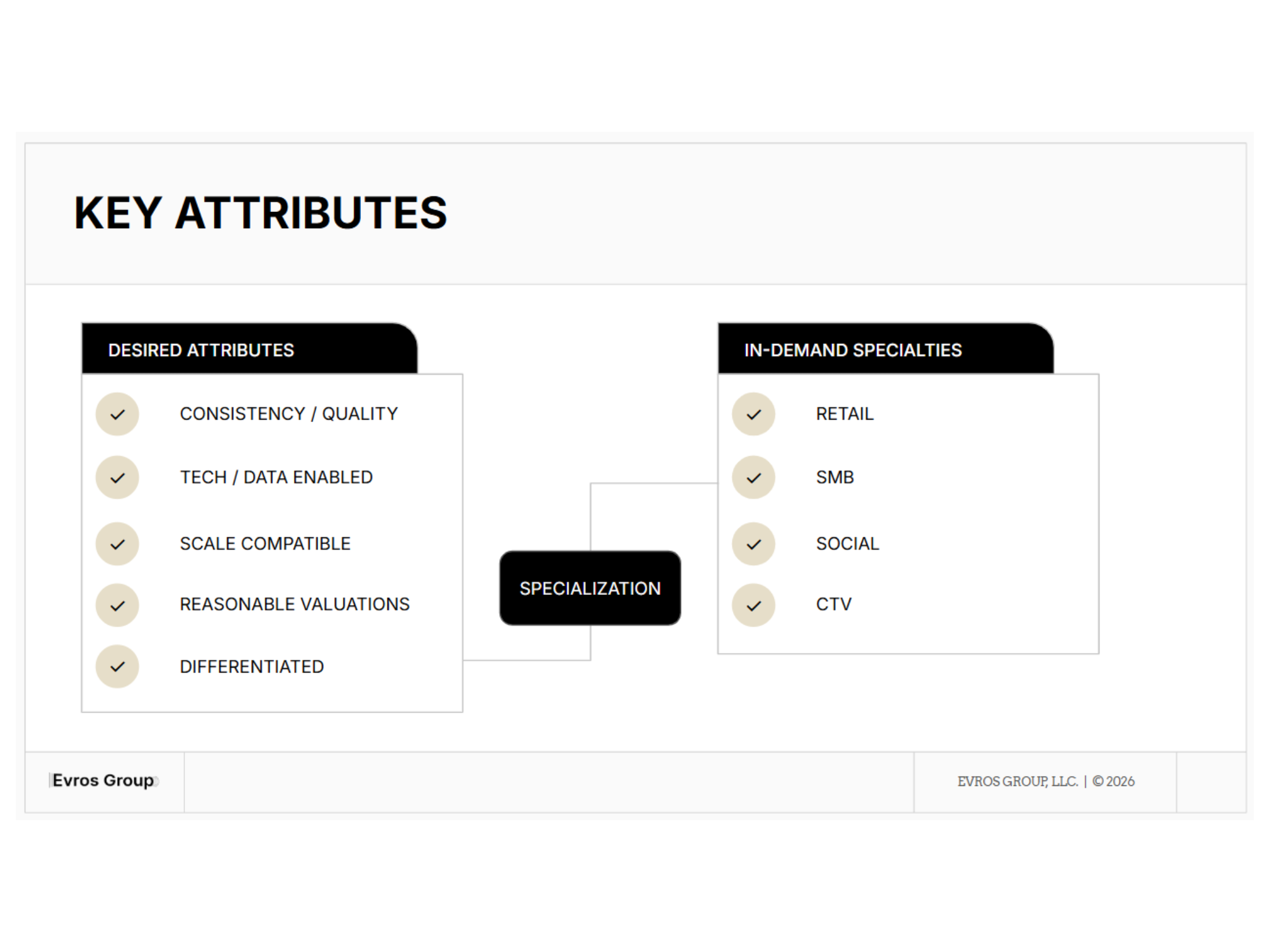
As Roell put it, scale is a valuation lever. Scale matters. Larger assets carry premium price tags because they often line up better with buyers' deployment needs. In his experience, agencies hitting around $5M+ of EBITDA start to see valuations climb dramatically. And part of that comes down to the simple economic reality of less scaled supply in the market.
In addition to scale — which has always added juice to the process — specialization is the new premium. There's been a notable shift away from broad general marketing firms toward differentiated, in-demand specialists. Roell called out several areas getting significant buyer attention right now: retail marketing, SMB and multi-location services, social advertising and CTV.
And this all comes with a practical takeaway. As an agency owner, you should consider whether one of your capabilities has the potential to stand out as a dominant specialty and give you a unique position in the market. Without casting other services aside, showing differentiation in a specialized category can act as a flywheel to unlock valuable leverage in any given transaction.
4. Good business hygiene maximizes price and supercharges deal certainty.
Serving as a major point of emphasis for both Roell and Ahene, both speakers made clear that thorough preparation and professionalization are vital component of any successful sales process.
They flagged a number of recurring friction points seen in deals, including accounting that doesn't hold up under scrutiny, loose legal agreements and a lack of early planning around things like tax considerations.
The good news: most of the disciplines that buyers want to see in a target company are also fundamental to running a strong business. Running a firm-wide stress test through a buyer’s lens most often leads to a better run business long term.
And Roell reminded founders that a deal doesn’t end on the closing date. Even in a full sale, buyers often structure transactions with sizable earnouts, meaning your future return is directly linked to having a business that is run clean and set for long-term success.
5. AI as a key part of diligence isn’t on the horizon. It’s here.
Far from being a future trends sidebar in this session, AI diligence was treated as a heavily weighted item in the 2026 market.
Roell acknowledged there's certainly a gap between how fast AI is moving and how clearly most buyers can evaluate it, but that doesn’t stop it from being a core component. And investors are routinely asking about the sustainability of any given business in the face of an AI-driven future.
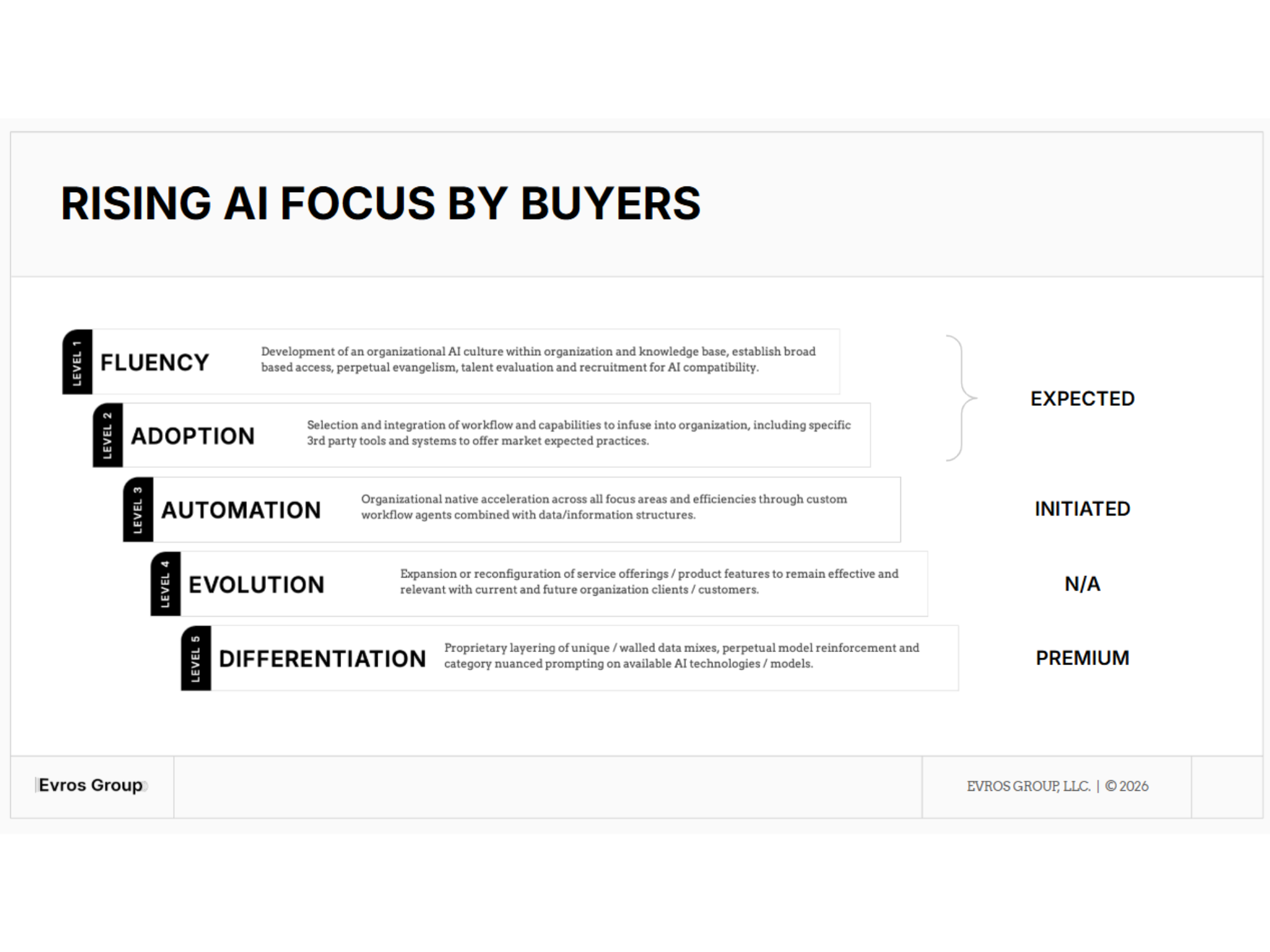
Given that AI adoption is now part of the table stakes, Roell described a five-level "sophistication ladder" and made the baseline expectation clear:
Levels 1–2 (adoption and usage): Expected today. Teams using AI, best practices in place, an understanding of what tools can be licensed and integrated.
Level 3 (workflow automation): Getting louder. Using AI to automate parts of delivery workflows, such as media-planning workflow automation.
Levels 4–5 (reimagined services + differentiated moats): Still emerging. Not widely expected yet, but agencies that can demonstrate real defensibility here can command premiums.
Regardless of where your company is at in it’s AI journey, Roell made clear that if you’re not implementing AI at all, you’re automatically going to get dinged in buyers’ eyes.
And as Ahene adds, it’s important that you’re not just implementing AI, but doing so in a way that is thoughtful and measurable via broader metrics like time to close, revenue per account, and retention. Sellers should assume their counterpart has to justify the deal to an investment committee. Meaning the more you equip your counterparty with supporting measurables for your AI strategy, the easier it will be for them to justify giving you a top-tier valuation.
The bottom line
Overall, the message of the webinar had one theme tying it all together: the best outcomes tend to go to founders who build intentionally over time with optionality in mind, not those who scramble at the last minute to secure the grand prize.
That approach naturally supports key levers that drive deal value — consistent performance, business hygiene, specialization, AI adoption — all implemented through the lens of what’s best for the business.
Because in the end, it’s the underlying strength of the organization that remains the greatest asset. And viewed in that light, value optimization becomes the through-line that strengthens the entire business.
Interested in diving deeper? You can add access the webinar here: