The New Rules of Agency M&A: Scale, Experience, and AI Are Rewriting the Playbook
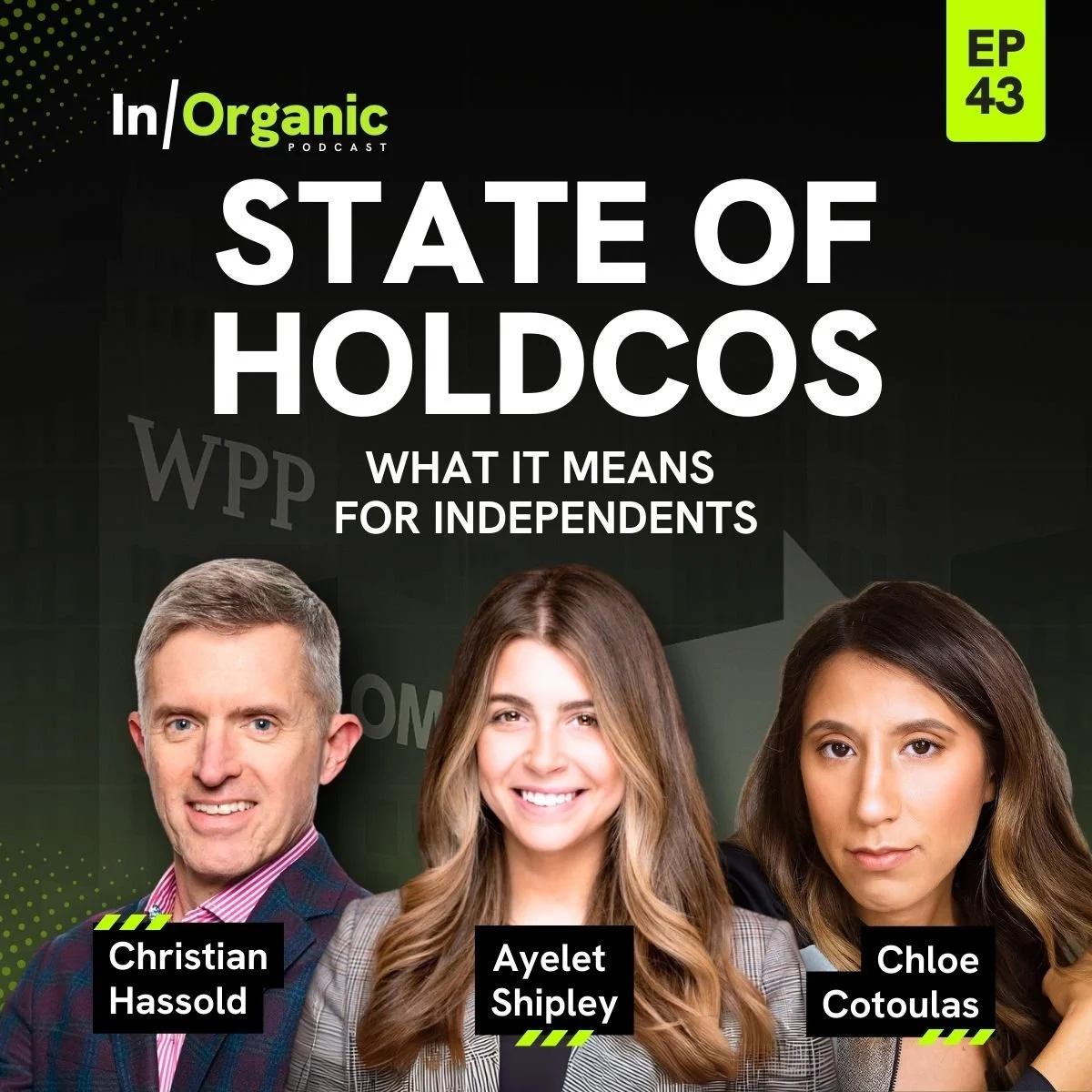
On a recent episode of The Inorganic Podcast, hosts Christian Hassold and Ayelet Shipley sat down with Chloe Cotoulas to unpack the forces reshaping agency M&A. Their conversation covered seismic holdco shifts, private equity’s renewed interest, the rise of experiential and community-driven marketing, and how AI is changing what’s defensible in the agency model.
Across the discussion, one theme was unmistakable: the old logic no longer applies. The next era of agency M&A will reward scale, technology integration, and creative companies that embrace change early — not those who rely on legacy positioning.
Holdco Consolidation Signals a New Power Structure
Chloe opened with breaking news: “It looks like Wednesday is the day that IPG–Omnicom merger is going to be finalized.” The announcement sent what she described as an “earth-rattling” signal across the industry.
The logic is simple: scale now matters more than ever — but the dominance of traditional holding companies is wobbling. WPP, once the global leader, is experiencing what Chloe bluntly called “a real crisis point,” noting that its stock price has fallen “nearly 60-70% year to date.”
This moment has attracted aggressive private equity attention. Firms like Apollo and KKR have begun “kicking the tires,” with KKR already having acquired WPP’s PR arm FGS last year.
But compared to the rollup era of 2020–2022, when media performance agencies like Wpromote and Tinuiti saw heavy investment, today’s PE lens is narrower and more technical. The focus has shifted from scaled media execution to technology-enabled models with defensible capabilities.
Tech-Led Agencies Are Redefining the Category
The last few years were about scaling media performance. The next era is about creative companies with a deep technical spine. Tinuiti’s recent AI-powered copy platform illustrates the shift: copywriting, testing, and optimization now happen automatically, at a speed and scale humans can’t match.
This doesn’t diminish creativity — it reframes it. As automation takes over execution, the leverage moves to the front of the process: original ideas, taste, systems thinking, and the frameworks that guide AI. Agencies who can articulate how technology makes their creativity stronger — not redundant — will set the pace for the industry.
Founders vs. Holdcos: “I’m Not Selling”… Until They Do
Almost every founder entering a process tells Chloe some version of the same thing:
“I’m not selling to a holdco.”
That resistance is often philosophical. Many independent agencies were built as a foil to the legacy holding company model. But as Chloe explains, part of the banker’s job is to widen the aperture.
For the right kind of founder — especially earlier in the growth curve — being acquired by a holdco can unlock enormous upside: doors opened, global connections, access to major accounts, and mentorship from leaders who’ve operated at scale for decades. She’s seen founders who were adamantly against a holdco exit ultimately sell and do “amazing within that ecosystem.”
The takeaway isn’t “everyone should sell to a holdco,” but rather that founders should treat it as a strategic option, not a moral stance.
The Rise of Experiential, Community, and Tech-Infused Environments
If there’s a category Chloe sees as especially hot right now, it’s experiential — the intersection of community, live engagement, and technology.
She highlights examples like:
The Intuit arena experience in Los Angeles, where fans use their phones for personalized, real-time engagement, changing how they interact with the game and the venue.
Work with platforms like Meta to rethink what a store even is in a world of smart glasses and augmented layers.
These aren’t just “nice-to-have” line items anymore. Budgets that once sat at the edges of the plan are now central spokes of the entire marketing strategy. In a fragmented, screen-first world, brands are hungry for ways to build real communities and shared experiences — both physical and virtual.
AI: What’s Defensible and Who Really Wins
AI, unsurprisingly, is a recurring theme — but Chloe’s take is more nuanced than “AI will replace agencies.”
She sees AI eroding the lowest-skill, most replicable work first: versioning, basic production, and other tasks agencies historically billed many hours against. Buyers are already asking whether pieces of the business — such as animation or visual effects — will simply be “the first to go.”
In a recent process involving Residence and its studio BUCK, Chloe watched buyers question whether AI tools would render a high-end animation and design shop obsolete. The answer, she argues, lies beneath the surface: the sophisticated internal technology and frameworks these studios are already building and using.
Agencies that embrace AI early, embed it into their workflows, and use it to amplify what they’re uniquely good at — taste, aesthetic judgment, conceptual thinking — will stand out. AI can replicate what exists; it cannot, on its own, imagine what comes next.
Christian adds that prompt engineers are becoming the new high-value hires. Copywriters still have a future — it just looks different than writing taglines in a vacuum.
Outlook: 2025, 2026, and the Separation of Winners and Laggards
Looking ahead, Chloe describes a busy Q4 with strong and accelerating deal flow. Leaders have continued to grow despite tariffs, macro noise, and shifting consumer appetites; weaker players have struggled more, widening the gap between winners and laggards.
With 2023 a weak year for many, she believes it will be critical for would-be sellers to show:
solid 2024–2025 performance, and
a credible, well-articulated 2026 outlook, including a clear AI story and a defensible role in the evolving ecosystem.
Founders who can combine strategic positioning, tech-enabled capabilities, and compelling, experience-led work will be best positioned — whether they ultimately partner with a holdco, private equity, or a strategic platform.
Watch, Subscribe, and Stay Tuned
Dig deeper into the ideas explored in this episode by watching “State of Holdcos and What It Means for Independents” on The Inorganic Podcast with hosts Christian Hassold and Ayelet Shipley.
For more insight from Chloe Cotoulas, explore the Numbers & Narratives playlist on Evros Group’s YouTube channel, where she breaks down the trends redefining modern marketing, media, and M&A.
Coming soon: our Q3 Earnings Report, featuring full analysis across platforms, holdcos, and emerging players driving the next cycle of growth.
Follow along for data-driven insights and founder-focused perspective — only on The Pulse.